Common Misunderstandings About ‘Oppa’ by International Viewers
📋 Table of Contents
The Korean word “Oppa” has become one of the most globally recognized terms, thanks to the worldwide popularity of K-pop, K-dramas, and the Korean Wave in general. If you’ve watched even a single romantic Korean drama or tuned into a live K-pop fan meeting, you’ve likely heard female fans or characters saying “Oppa~” in soft, sometimes teasing voices that carry a world of emotion.
At first glance, it might seem like a simple nickname—a cute, flirty way to refer to a crush or boyfriend. But the reality is much deeper, and the term carries more layers than most non-Koreans realize. “Oppa” is not just a word; it’s a cultural marker. It represents gender roles, social hierarchy, emotional nuance, and evolving language within Korean society.
Unfortunately, as Korean pop culture spread across the globe, many of these complexities got lost in translation. International fans often adopt the term without fully understanding the social etiquette or implications behind it. Sometimes it’s cute; other times, it can be cringeworthy—or worse, unintentionally disrespectful.
In this post, we’re going to break it all down. What does “Oppa” really mean? When is it appropriate to use? Is it romantic by default? What do Koreans actually think when foreigners use the word? We'll explore all of this in detail—diving into the cultural fabric, dissecting 20 of the most common misunderstandings, and offering clear context so you can engage with Korean language and culture more meaningfully.
Whether you're a longtime drama addict, a loyal ARMY, or just someone who's curious about Korea, this deep dive will help you move from imitation to genuine cultural understanding. Let's go beyond the surface of "Oppa" and see what it truly means beneath the smile and sparkle. 💫
👨👧 What Does “Oppa” Actually Mean?

At its core, “Oppa” (오빠) means “older brother” in Korean, specifically used by a female speaker to address a male who is older than her. It's a gendered and age-based honorific, which forms part of the broader Korean language system that emphasizes hierarchy, politeness, and relationship status.
But here’s where it gets interesting: the term is not restricted to literal family. A girl might call her biological brother “Oppa,” but she might also use it for a male friend, a senior at school, or someone she’s dating. The common thread? The man is older, and there’s some level of emotional closeness or familiarity.
So does that mean “Oppa” equals “boyfriend”? Not quite. While the word can be romantic depending on tone and context, its fundamental meaning is broader. Many non-Koreans latch onto the romantic interpretation because of what they see in K-dramas or K-pop culture, but Koreans themselves know the word’s meaning isn’t fixed.
Tone plays a massive role in how “Oppa” is interpreted. A woman might say it warmly, jokingly, pleadingly, or sarcastically. Each tone colors the word with different intent—flirtation, affection, frustration, or even mockery. That’s something subtitles often can’t capture.
In fact, English translations frequently simplify the term to words like “babe,” “sweetie,” or even just a name. While these may fit the tone in a given scene, they strip “Oppa” of its cultural specificity and relationship-based nuance.
It’s also worth noting that “Oppa” is strictly for females. Males use “Hyung” (형) when addressing an older male, and “Noona” (누나) when talking to an older female. The honorific system is very gender-specific, which is often surprising to those from more gender-neutral language cultures.
What makes “Oppa” stand out is its fluidity. A girl might use it casually with a close friend one moment and then romantically with her boyfriend the next. This flexibility can be empowering—but also confusing for outsiders trying to decode its true meaning.
The context determines everything. Calling someone “Oppa” just because he’s older is not appropriate unless there’s a personal relationship. Using it with a stranger, especially as a foreigner, can come across as forced or even disrespectful.
That’s why it’s essential to understand the relational framework of Korean society. Language reflects connection, and words like “Oppa” are social signals as much as they are terms of address. Koreans pick up on whether your usage is genuine—or just copying what you saw in a K-drama.
So before calling someone “Oppa,” think about your relationship to them, how well you know them, and the context you're in. It’s a beautiful word, but only when used with cultural awareness. 🧠
🚫 20 Misconceptions Among International Fans

1. “Oppa” always means “boyfriend”
This is probably the most common misunderstanding. Many fans think that if a girl calls someone “oppa,” it means they’re dating. But in reality, the word literally means “older brother,” and it can be used in platonic, familial, or romantic contexts. It’s all about tone and relationship, not the word itself.
2. “Oppa” is a romantic term by default
In K-dramas, we often see women using “oppa” to flirt, so many assume it’s inherently romantic. But a younger sister also says “oppa” to her actual brother. It only takes on romantic meaning depending on voice, mood, and situation.
3. All Korean men like being called “oppa”
Actually, no. Many Korean men feel awkward or even uncomfortable being called “oppa” by strangers or fans who aren’t close to them. It can come off as overly familiar or unnatural—especially in formal settings.
4. Foreigners should use “oppa” to sound cute
Trying to sound Korean by using “oppa” can backfire. It’s okay to appreciate Korean terms, but randomly calling someone “oppa” without understanding context can feel performative or even embarrassing.
5. “Oppa” is used in all situations
Nope. You shouldn’t say “oppa” in formal or professional situations. Calling your boss or a male teacher “oppa” would be completely inappropriate unless you’re very close outside of work, which is rare.
6. Boys can say “oppa” to each other
Absolutely not. Only females can use “oppa” for older males. If a boy is speaking to an older male, he uses “hyung.” Using the wrong word can make you sound silly or confused.
7. “Oppa” means “idol”
Fans often call male idols “oppa,” so some assume the word means “celebrity” or “idol.” That’s incorrect. It’s a personal term that happens to be used in fandoms—but not all male idols are “oppa” to every fan.
8. You can call anyone “oppa” if they’re older
Even if a man is older, calling him “oppa” without familiarity or closeness can seem rude. It assumes a level of intimacy that might not be there.
9. “Oppa” is interchangeable with “babe”
Western fans often use “oppa” like “babe” or “sweetheart,” but they’re not equivalent. “Oppa” has many shades of meaning—from sibling warmth to flirtation—while “babe” is usually romantic.
10. Using “oppa” makes you more Korean
Language isn’t cosplay. Using Korean terms without context doesn’t bring you closer to the culture unless you also understand the nuance and respect embedded in them.
11. “Oppa” can be used in sarcasm without issue
Sarcastically saying “oppa~” in a mocking tone might seem funny to non-Koreans, but in Korea, it can feel disrespectful—especially if you’re imitating the culture without real understanding.
12. All girls use “oppa” with boyfriends
Not all couples like this term. Some avoid it because of its associations with infantilization or K-drama clichés. Modern couples may opt for names, nicknames, or simply "jagiya" (honey).
13. “Oppa” is fine to use after just one meeting
Nope. It’s a word that usually follows familiarity. Using it too soon can feel presumptuous—like assuming closeness that doesn’t yet exist.
14. Idol “oppa” means real connection
Calling an idol “oppa” doesn’t mean you have a real bond with them. It’s part of the parasocial experience—feeling close, even though the relationship is one-sided.
15. It’s just a harmless nickname
Sometimes true—but not always. Depending on the setting, using “oppa” too lightly or frequently can make others uncomfortable.
16. Older women never use “oppa”
Wrong. As long as the man is older and the woman feels it’s appropriate, she can use it—even if she's in her late 30s or 40s. The key is the relationship, not just age.
17. It’s only used by straight women
No—anyone identifying as female can use “oppa” regardless of orientation. It’s based on gender and age roles, not sexuality.
18. You can translate “oppa” as “dear” or “sweetheart” in all cases
Nope. Sometimes it just means “brother.” Subtitles can mislead when they swap “oppa” for romantic terms without checking the context.
19. All women love calling their partners “oppa”
Some feel pressured to use it to seem cute or feminine, especially due to media portrayals. But not all women like that dynamic.
20. “Oppa” is always positive
Depending on tone, it can express anger, sarcasm, or even insult—just like any word. It’s not always affectionate.
🎬 Media’s Role in Redefining “Oppa”

It’s no exaggeration to say that Korean media—especially K-dramas and K-pop—have completely reshaped how “oppa” is perceived around the world. Originally a familial or respectful term, “oppa” has become a buzzword associated with romance, charm, and fan culture. Why? Because that’s how it’s consistently portrayed in entertainment.
In romantic dramas, the female lead often uses “oppa” in moments of emotional vulnerability. Whether she’s shyly confessing love, calling out in distress, or teasing affectionately, the word is loaded with feeling. Over time, this repeated use in scripted scenes created a strong association between “oppa” and romantic interest.
K-pop took it even further. Male idols frequently encourage fans to call them “oppa” during fan meetings, livestreams, and performances. It adds to the parasocial illusion—making fans feel emotionally connected to someone they've never met. Many fans love the closeness and use the word freely in fan spaces.
This phenomenon, often called “fan service,” is intentional. Agencies and artists know that the use of terms like “oppa” strengthens the idol-fan bond. But it’s crucial to understand: this is a performance, a curated experience—not an everyday reflection of Korean language norms.
What makes things more confusing is the way Korean honorifics are translated in subtitles. Since there’s no direct English equivalent for “oppa,” translators often substitute words like “babe,” “sweetheart,” or just the person’s name. While these may fit the emotional tone, they miss the layered meaning.
For instance, when a sister says “Oppa, can you drive me to school?” it’s often translated simply as “Can you drive me?”—completely removing the respectful, age-based nuance of the original line. Meanwhile, when a girl flirts with her crush and calls him “oppa,” it might be rendered as “babe,” which can overemphasize the romantic element.
Over time, international viewers began to internalize these mistranslations. Many now believe “oppa” equals “boyfriend,” even though a Korean viewer would understand that same scene as playful or respectful without necessarily being romantic.
Even fan-made content contributes to the confusion. TikToks, fanfics, reaction videos, and meme pages often portray “oppa” in exaggerated or comedic ways—further disconnecting it from its cultural roots. It’s cute and fun, yes—but not accurate.
That’s not to say media is bad. In fact, K-dramas and K-pop have played a huge role in spreading Korean language and culture. But when one version of a word is repeated over and over, it can narrow the global understanding of that word’s real use.
So if you first heard “oppa” in a drama or concert, that’s perfectly fine. Just remember—it’s a performance, not a prescription. Learn the meaning behind the moment, and you’ll gain both cultural insight and deeper appreciation. 🎧📺
🎎 Cultural Contexts and Honorifics
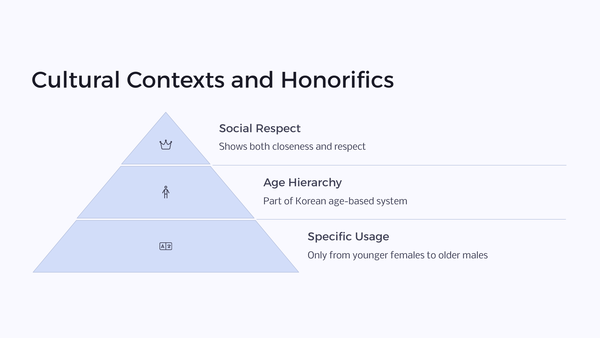
To truly understand how “oppa” works, you have to look at the broader system of honorifics in Korean language and culture. Unlike many Western languages, Korean speech changes depending on the social status, age, and familiarity between the people speaking. These layers of formality are built into everyday expressions, and “oppa” is one of the most telling examples.
Korean society places a strong emphasis on age hierarchy. It’s common for people to ask each other’s age almost immediately upon meeting. That’s because knowing someone’s age tells you how to address them, what tone of speech to use, and even how to act around them. “Oppa” is directly tied to this structure—it is not just a nickname, but a linguistic acknowledgment of someone's seniority and your relationship to them.
This is especially important in the context of gender. “Oppa” is exclusively used by women when referring to older males. There’s no unisex version of the word. If a man talks to an older male, he would use “hyung.” If he speaks to an older woman, he uses “noona.” And a woman would call an older female “unnie.” Each term marks not just age, but also gender roles and social distance.
When you use “oppa,” you're implicitly placing the man in a respected, senior role. This may come with affection, admiration, or romantic tension—but also with an expectation of protectiveness or leadership. That’s why the word can carry emotional weight, even when used casually.
There’s also etiquette around when and how to use it. You don’t call someone “oppa” unless there’s enough closeness to justify that familiarity. For example, in school or the workplace, it would be odd or even inappropriate to use “oppa” for someone you barely know. Instead, people use job titles or “seonbaenim” (선배님)—a more formal way to address a senior.
In casual settings, however, using “oppa” can help build rapport. Many women use it to refer to older classmates, church group members, or male friends they’ve known for a long time. It softens the mood and establishes a warm social dynamic, especially when paired with informal speech endings like “-ya” or “-eun.”
Interestingly, some Korean women feel conflicted about the term. As feminist conversations grow within Korea, some criticize how “oppa” can reinforce traditional gender expectations. In romantic contexts, women may feel pressured to act cuter or more submissive when using the word, feeding into certain stereotypes.
At the same time, many women proudly use “oppa” with confidence and control. They redefine the term on their own terms—sometimes using it ironically or with assertiveness, flipping the power dynamics that the word may traditionally imply. Language, after all, evolves with the people who use it.
So if you’re a non-Korean speaker wanting to use “oppa,” it’s important to learn not just the literal translation, but the social framework that gives it meaning. Otherwise, the word becomes hollow—used without the context that makes it matter in the first place.
In Korean, saying the right word isn’t enough. You have to say it the right way, at the right time, to the right person. And that’s what makes “oppa” so fascinating. 🌐
🎭 Tone, Body Language, and Usage
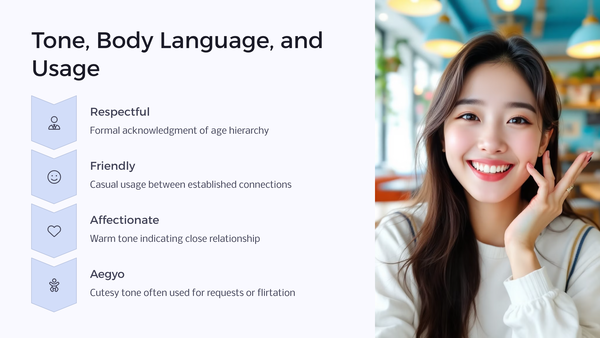
In the Korean language, what you say matters—but how you say it matters even more. The word “oppa” is a perfect example of this. The same word can express love, frustration, sarcasm, or even anger depending entirely on tone, facial expression, and context. That’s why so many non-Korean speakers misinterpret its meaning in conversation or in dramas.
Say “Oppa~” in a soft, drawn-out voice with wide eyes and a smile? It’ll sound flirty or affectionate. Say it in a flat, sharp tone with a sigh? It might mean you're annoyed or demanding something. Koreans intuitively read into this without thinking twice—but for outsiders, these subtleties are easy to miss.
In K-dramas, this tonal shift is often dramatized for effect. A female character might say “Oppa!” sweetly to charm someone, then switch to a stern “Oppa…” when she’s angry. The word hasn’t changed, but the delivery transforms the meaning completely.
Body language also plays a key role. A tilt of the head, a pout, folded arms, a playful touch—all these non-verbal cues help the listener decode the speaker’s emotional intention. In fact, “oppa” is almost never said in a vacuum. It’s always part of a broader emotional message.
That’s why English subtitles can’t always capture the real impact of the word. You might see “oppa” translated as “babe” in a drama, but in that scene, the character could actually be scolding the man or expressing concern. It’s easy to lose the nuance.
In real life, the situation and relationship define how “oppa” should be said. A girl might say “oppa~” playfully when asking her boyfriend to buy her food. But if her brother annoys her, the same word might come out as “Oppa!” with a furrowed brow and irritated tone. Same syllables—very different meanings.
Because of this, Korean learners and fans often overuse or misuse “oppa” with a tone that feels unnatural to native speakers. Mimicking a tone from a drama can seem forced or even mocking if the setting isn’t right. Context always comes first.
Some Koreans even joke about “oppa voice” or “aegyo tone” (cute tone), referring to the exaggerated way some women say the word to get what they want. It’s a cultural trope—part sincere, part parody—but even within Korea, people are aware of how performative it can be.
It’s important to know that the way you say “oppa” can change how you're perceived. If you’re too familiar, it can seem inappropriate. If you're too stiff, it can feel awkward. But if you match tone, timing, and context, the word fits naturally into conversation and feels truly respectful or affectionate.
My personal take? I think “oppa” is one of the most emotionally flexible words in Korean. It lets you express closeness, humor, affection, or even power, all in two syllables. That’s what makes it so beautiful—and so tricky to get right. 💬
🌀 Shifting Meaning Through Generations
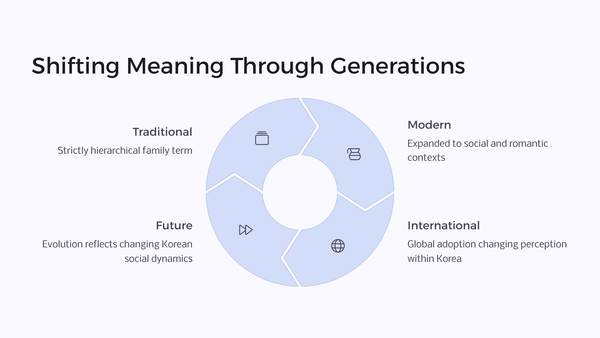
Like any living language, the meaning and use of the word “oppa” has evolved over time. What began as a simple way for girls to address older brothers has become a cultural symbol wrapped in layers of emotion, media influence, gender dynamics, and fandom behavior.
In older generations, “oppa” was used almost strictly within families or among close acquaintances. Girls used it for their older brothers, or for long-time male friends who were slightly older. The word carried warmth and respect, but there was little performance in it—it was just part of daily life.
Fast forward to the 1990s and early 2000s, when Korean dramas began dominating prime time TV. Suddenly, “oppa” was no longer just a familial term—it was being whispered in romantic scenes, screamed in moments of heartbreak, and teased playfully during love triangles. Viewers began associating it with romance and longing.
Then came K-pop. As idol culture grew, “oppa” became a term of fandom affection. Fans would cheer it at concerts, write it in fan letters, and scream it during live broadcasts. Idols themselves encouraged it as part of “fan service,” creating an illusion of closeness and intimacy.
But this new usage started blurring the lines. For many international fans, “oppa” now means “K-pop crush” or “dream boyfriend,” even though that’s not how the term is used in everyday Korean life. The word’s original meaning has been reshaped by media portrayals and global fandom culture.
Meanwhile, in Korea, younger generations have also begun to reinterpret the term. Some women still use it affectionately, especially in relationships. Others avoid it entirely, seeing it as old-fashioned or connected to stereotypical gender roles. There’s even a bit of social satire in how “oppa” is used today—sometimes ironically, sometimes to critique societal norms.
Online culture has added more complexity. In meme culture, “oppa” is exaggerated, turned into jokes, or even used mockingly to parody over-the-top K-drama scenes. Social media influencers may use it in skits or TikToks with a wink, knowing the audience gets the trope.
Because of this constant evolution, some Koreans feel conflicted about the term’s current status. Is it romantic? Is it sarcastic? Is it sincere? The answer is: it depends. More than ever, “oppa” now depends on tone, generation, platform, and context.
Still, this flexibility can be a good thing. It shows that language isn’t static—it bends and changes with time, culture, and people. Whether used affectionately, ironically, or traditionally, “oppa” reflects the ongoing conversation between Korea’s past and present.
So if you're engaging with the term, do it with awareness of its roots—but don’t be afraid to recognize its new layers. “Oppa” is no longer just a word. It’s a window into Korean culture, identity, and the way language evolves. 🕰️
❓ FAQ

Q1. What does “oppa” literally mean?
It literally means “older brother” and is used by a younger female when speaking to an older male. But its meaning can vary widely depending on context, tone, and relationship.
Q2. Is it okay for non-Koreans to use the word “oppa”?
Yes, but only if it’s used appropriately and with cultural understanding. Using “oppa” without context can feel awkward or insincere to Korean speakers.
Q3. Can a girl call her boyfriend “oppa”?
Absolutely. Many Korean women use “oppa” in romantic relationships to show affection. But not every couple uses it—it’s a personal choice.
Q4. Can guys say “oppa” to their older male friends?
No. Males use “hyung” (형) to address older males. “Oppa” is exclusively used by females.
Q5. Is calling a K-pop idol “oppa” acceptable?
Yes, in fan culture it’s very common. Idols often invite this form of address as part of fan engagement. But outside of fan events or media, use it carefully.
Q6. Is “oppa” always romantic?
No. It can be romantic, familial, or platonic. Context is everything. A younger sister calling her real brother “oppa” has no romantic connotation at all.
Q7. Can “oppa” be used sarcastically?
Yes, tone changes everything. A woman can say “oppa~” teasingly, angrily, or even mockingly. Koreans pick up on these shifts very quickly.
Q8. What should I use instead of “oppa” in professional settings?
Use job titles or formal honorifics like “seonbaenim” (선배님), or just their full name with “-nim.” “Oppa” is too casual for the workplace or formal situations.
'🎬 K-Drama World' 카테고리의 다른 글
| What Is “Oppa” in K-Dramas? Real Meaning and Use (1) | 2025.06.03 |
|---|---|
| ‘Oppa’ in K-Dramas: Romantic Meaning vs Casual Use (0) | 2025.06.01 |
| Why Do K-Drama Heroines Always Say ‘Oppa’? (0) | 2025.05.31 |
| What Do Real Koreans Think About ‘Oppa’? (0) | 2025.05.30 |


